
阿伦尼乌斯方程带来的误导:芯片运行寿命随温度的变化
当芯片过热时,其可靠性会下降。但这只是一个定性的规律。为了能预测芯片的运行寿命或者故障率,必须获得可靠性和温度之间的具体关系。
一个被广泛使用的简单方式是温度每上升10℃,元器件运行寿命减半。这一结论的依据是阿伦尼乌斯方程(或公式):
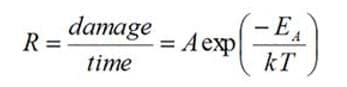

式中A是化学反应常数,EA是活化能,k是玻尔兹曼常数,T是绝对温度。阿伦尼乌斯方程描述的是化学反应的速率常数与温度之间的关系式,适用于基元反应和非基元反应。
对于同一个芯片,在比较不同问工作温度下其可靠性差别时,可以作如下变化:
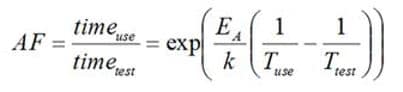
可以看到,衰减因子与温度之间的关系实际上和活化能有关。不同失效机制下的活化能是不同的。只有在活化能为~0.8 ev时,衰减因子在常规芯片温度范围内(~80C)才接近2.下表列示了不同失效机制下化学反应的活化能范围,可以看到,活化能为0.8 ev仅能代表电子迁移过程,氧化、腐蚀、硅形变等均低于此值。而污染、电荷注入过程的活化能则高于此值。
| Failure Mechanism |
Activation Energy |
Screening and Testing Methodology |
Control Methodology |
| Corrosion | 0.45ev | Highly Accelerated Stress Test ing (HAST). |
Passivation dopant control, hermetic seal control, improved mold compounds, and product handling. |
| Oxide Defects | 0.3 – 0.5eV | High Temperature operating life (HTOL) and voltage stress. | Statistical Process Control of oxide parameters, defect density control, and voltage stress testing. |
| Silicon Defects (Bulk) |
0.3 – 0.5eV | HTOL and voltage stress screens. | Vendor statistical Quality Control pro grams, and Statistical Process Control on thermal processes. |
| Assembly Defects | 0.5 – 0.7eV | Temperature cycling, tempera ture and mechanical shock, and environmental stressing. |
Vendor statistical Quality Control pro grams, Statistical Process Control of assembly processes, and proper handling. |
| Electromigration – Al line – Contact/Via |
0.6eV 0.9eV |
Test vehicle characterizations at highly elevated temperatures. |
Design process groundrules to match measured data, statistical control of met als, photoresist and passivation. |
| Mask Defects/ Photoresist Defects |
0.7eV | Mask Fab comparisons, print checks, defect density monitor in Fab, voltage stress test and HTOL. |
Clean room control, clean mask, pellicles, Statistical Process Control of photoresist/ etch processes. |
| Contamination | 1.0eV | C-V stress of oxides, wafer fab device stress test and HTOL. |
Statistical Process Control of C-V data, oxide/interconnect cleans, high integrity glassivation and clean assembly process. |
| Charge Injection | 1.3eV | HTOL and oxide characteriza tion. |
Design groundrules based on test results, wafer level Statistical Process Control of gate length and control of gate oxide thickness. |
Acceleration Factor for a 10°C Temperature Increase
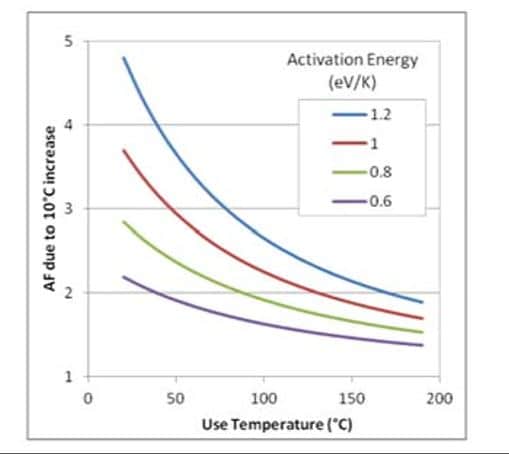
芯片的失效机制非常复杂,这一方程实际上只是针对特定失效机制才有意义的。大量数据证实“10C=1/2”的公式是不合适的。当活化能变高,衰减程度会加剧;活化能降低,衰减程度又会缓解。